
Director
Scott Solomon, Teaching Professor of Biosciences
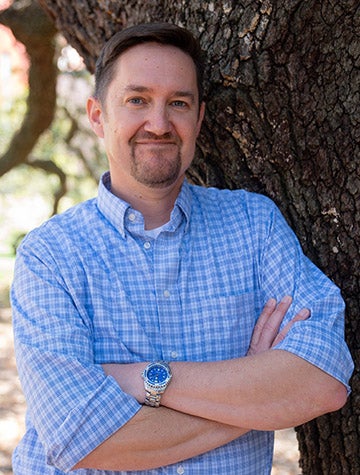
Scott Solomon is a biologist, professor, and science communicator. He has a Ph.D. in Ecology, Evolution, and Behavior from the University of Texas at Austin where his research examined the evolutionary basis of biological diversity in the Amazon Basin. His popular writing and photography have appeared in publications such as The Washington Post, National Geographic, The Globe and Mail, Slate, Aeon, Nautilus, MIT Technology Review, NBC News, and Wired.
Solomon’s latest book, Becoming Martian: How Living in Space Will Change Our Bodies and Minds was published by MIT Press on Feb 17, 2026. He is also the author of Future Humans: Inside the Science of Our Continuing Evolution (Yale University Press), which was included on the 2017 Best Book List by the American Association for the Advancement of Science (AAAS).
Solomon is the creator and host of the podcast Wild World with Scott Solomon. He has appeared on numerous television and streaming series such as ABC News, Life 2.0 and NASA’s Unexplained Files, radio broadcasts on NPR and the BBC World Service, as well as webinars and podcasts such as Modern Wisdom, Quirks and Quarks, Professor Dave Explains, Daniel and Kelly’s Extraordinary Universe, and Science Fantastic with Michio Kaku. He co-wrote and co-produced a three-part docu-series for CuriosityStream called Becoming Martian released in 2021. He regularly speaks about science at schools, museums, churches, science cafés, TEDx events and other venues.
He teaches courses at Rice in ecology, evolutionary biology, and scientific communication and has taught field biology courses in the savannas of East Africa, in the rainforests and reefs of Belize, and the Rocky Mountains of Colorado. He developed a series of online introductory biology and science communication courses through Coursera as well as two complete digital series with The Great Courses called Why Insects Matter: Earth’s Most Essential Species and What Darwin Didn’t Know: The Modern Science of Evolution. He also hosts educational travel experiences in wild places around the world, from Antarctica to the Galapagos Islands and more. He is a Fellow of The Explorers Club and a member of the American Association for the Advancement of Science, the Sigma Xi Scientific Research Honor Society, and the Society for the Study of Evolution.
SCOPE Advisory Board
Scott Solomon (chair), Biosciences
Lauren Kapcha (ex officio), Wiess School of Natural Sciences
Kyung-Hee Bae, Center for Academic and Professional Communication
Joe Campana, English and Creative Writing
Luis Campos, History
Matthew Cushing, Office of STEM Engagement
Kirstin Matthews, Baker Institute
Doug Natelson, Physics and Astronomy
Kirsten Siebach, Earth, Environmental and Planetary Sciences
Melinda Spaulding Chevalier, Public Affairs
Tracy Volz, Activate Engineering Communication Program
Jennifer Shade Wilson, Program in Writing and Communication
Jane Zhao, Digital Media Commons
SCOPE Fellows
Daniel Cohan, Professor of Civil and Environmental Engineering
I frequently engage with the public and the media through talks, op-eds, and interviews related to my expertise in air quality, climate, and energy.
Kory Evans, Assistant Professor of Biosciences
I am a naturalist and evolutionary biologist who works to educate the general public about the natural world. I engage in science communication in the form of video productions, media interviews, social media and public talks.
Jon Flynn, Associate Teaching Professor of Biosciences
I organized 60+ events with Taste of Science, where we had scientists speak at casual venues (bars/restaurants/cafes). I also run BrainSTEM, where we have 40+ undergrads go to schools on a weekly basis and teach active lessons in neuroscience to K12 students in 4 different Houston area schools.
Cassidy Johnson, Assistant Teaching Professor of Biosciences
I design and deliver community presentations on the essential role of regional ecosystems in an effort to inspire individuals to take an active role in conserving our native flora and fauna.
Kirstin Matthews, Fellow in Science and Technology Policy, Baker Institute
I work in science policy, which involves working with scientists to communicate their research and the applications of their work to policymakers and the broader public who supports it.
Douglas Natelson, Harry Carothers Wiess Chair of Physics
I have been writing a blog (https://nanoscale.blogspot.com) about condensed matter physics, nanoscale science, and other aspects of science since 2005. I have also written for Scientific American and communicate with regularity with science journalists.
Kirsten Ostherr, Gladys Louise Fox Professor of English
My research on trust and privacy in digital health ecosystems has been featured in The Washington Post, Marketplace Tech, The Atlantic and STAT. My work on humanistic AI and health equity includes, “Artificial Intelligence and Medical Humanities,” “Patient Participation in AI for Health Curriculum,” a “Responsible AI for Health” curriculum supported by the National Humanities Center, and the NEH-funded “Center for Humanities-based Health AI Innovation” with Baylor College of Medicine.
Patricia Reiff, Professor of Physics and Astronomy
Space scientist involved in the study of the magnetosphere and "space weather". Frequent commentator on eclipses, lunar science, and space weather, and developer and distributor of educational planetarium shows and software.
Kirsten Siebach, Assistant Professor of Earth, Environmental and Planetary Sciences
I am a planetary geologist with over 18 years of experience operating surface missions on Mars, and I love to share the images and stories of Mars exploration with students, interest groups, and the public through lectures, documentaries, and media interviews for news, TV, radio, and podcasts.
Kelly Weinersmith, Adjunct Assistant Professor of Biosciences
I co-wrote the New York Times bestsellers "Soonish: Ten Emerging Technologies That'll Improve And/Or Ruin Everything" and "A City on Mars: Can We Settle Space, Should We Settle Space, and Have We Really Thought This Through?". I have also co-organized/co-produced live science-themed events (including "Moms on Mars," and the "Festival of Bad Ad Hoc Hypotheses" or BAHFest), and I co-host the podcast "Daniel and Kelly’s Extraordinary Universe."
SCOPE Affiliates
Eric Berger, Founder, Space City Weather
I have been a science journalist, first at the Houston Chronicle, and later at Space City Weather and Ars Technica, since 2001.
Daisy Chung '14, Graphics Journalist and Science Illustrator
I create award-winning graphics explainer stories and infographic designs both digitally and in print, with a focus on environmental and biological topics.
Stephen M. Cohen '89, '92, Independent Scholar
I try to raise appreciation of chemistry to the general public and non-science academia. I have written books ("O Mg! How Chemistry Came to Be, World Scientific, 2022; "America's Scientific Treasures," 2nd. ed., Oxford U Press, 2020) and journal articles on Yiddish chemistry literature, plus ran the podcast "The History of Chemistry."
Richard Tresch Fienberg '78, Astronomer, Educator & Science Communicator
I spent 22 years as a writer/editor at Sky & Telescope magazine and 12 years as press officer of the American Astronomical Society. I've led astronomy tours worldwide for 35 years, and even in retirement, I continue to write popular articles and give public talks.
Erin Mills, Manager of Programs and Partnerships at Enchanted Forest Nursery
I coordinate, plan, and teach educational programs on gardening and environmental stewardship for Enchanted Forest Nursery in Richmond, Texas. I also give talks for various groups about insects, with a focus on their complex relationships with plants.
Niamh Ordner '26, Science Reporter
I am a science journalist and former AAAS Mass Media Fellow with a background in biological research. My reporting on public health, policy and scientific research has appeared in The Dallas Morning News, the Los Angeles Times and Smithsonian Magazine.
Ulyana Horodyskyj Pena '07, Associate Scientist, University of Colorado Boulder
My work focuses on making science accessible through public engagement and educational outreach, connecting people with research from the Arctic, Antarctica and the Himalaya to foster greater understanding of our changing planet.
Sarina Peterson, Co-Owner of Amoeba Sisters YouTube Channel
As co-creator and illustrator of the Amoeba Sisters YouTube Channel, I use cartoons to make science concepts more engaging and accessible with humor and relevance. The Amoeba Sisters educational videos and resources support learners and educators around the world.
Brianna Rapini, Co-Creator of Amoeba Sisters YouTube Channel
I am the script writer and voice for the Amoeba Sisters YouTube channel. I am a former high school biology teacher and use that experience to make complex biology concepts clear, engaging and accessible to a broad public audience.
Lillie Stockseth '22, Behavior Change Project Manager, Houston Zoo
I design and evaluate behavior change initiatives that empower the public to take meaningful conservation action. My work integrates science communication into public programs, campaigns, and partnerships that transform awareness into measurable wildlife conservation impact.
Daniel Whiteson '97, Professor of Physics & Astronomy, UC Irvine
I am the co-author of several popular science books, "We Have No Idea" and "Do Aliens Speak Physics?", the co-host of the podcast "Daniel and Kelly's Extraordinary Universe" and co-creator of "Elinor Wonders Why."