
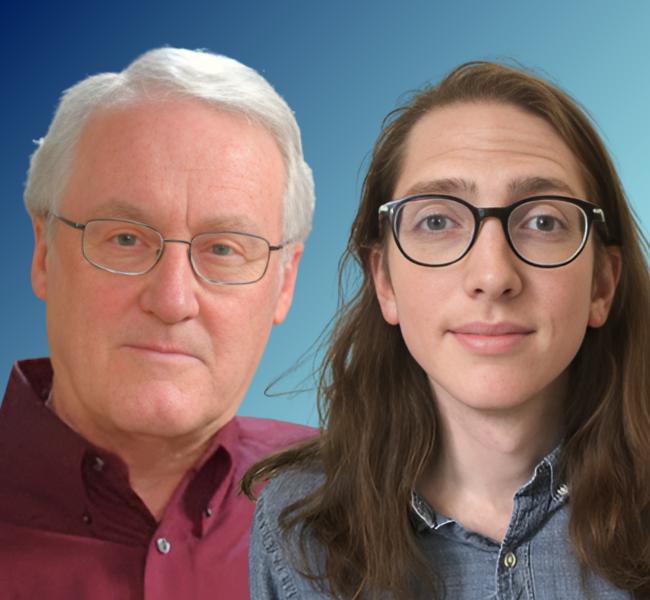
The School of Natural Sciences will honor two alumni whose careers have helped shape fields ranging from infectious disease research to artificial intelligence at this year’s awards dinner during Alumni Weekend, Nov. 12-14.
R. John Collier ’59 will receive the Distinguished Alumni Award, while Nick Ryder ’14 will receive the Recent Alumni Award. The awards recognize alumni who have demonstrated exceptional achievement, leadership and impact in their professions and communities.
John Collier ’59
2026 Distinguished Alumni Award
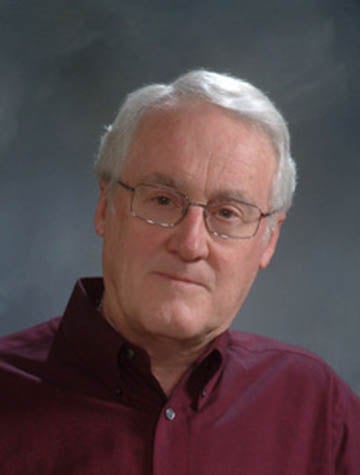
A 1959 graduate in biology, Collier built a pioneering research career studying how bacterial toxins act on human cells. His work helped establish that the toxins responsible for bacterial diseases such as diphtheria, cholera, tetanus and anthrax are peculiar proteins that are able to enter cells and disrupt essential biological processes within. His discoveries influenced vaccine development and modern therapeutic approaches.
Collier, now the Maude and Lillian Presley Professor of Microbiology Emeritus at Harvard Medical School, said his scientific trajectory began at Rice through a formative mentorship with biology professor Allen Enders.
“In my junior year,” Collier said, “ I took a course on cell biology, taught by Professor Enders. The subject caught my fancy, and I started hanging around his lab, where I gained a sense of what scientific research was all about.”
That relationship ultimately changed the course of his career.
“I’d been a pre-med at Rice, but Prof. Enders persuaded me to apply to graduate school,” Collier said. “I was accepted at Harvard and decided to give it a try.”
After arriving in the Biology department at Harvard, Collier became fascinated by research on how diphtheria toxin killed human cells and the broader question of how bacteria cause disease.
“Here you had an opportunity to understand how a bacterium kills a man by determining how a toxic protein kills human cells,” he said. “I was intrigued by that concept.”
Throughout a career spanning decades at the University of California, Los Angeles, and Harvard, Collier maintained a highly focused research program centered on uncovering the mechanisms and structures of bacterial toxins.
“I studied mainly two toxins, diphtheria and anthrax, seeking an ever more detailed understanding of the structures of these lethal proteins and how they crossed membranes.”
Reflecting on his education, Collier credited Rice with providing both rigorous scientific training and a supportive academic environment.
“At Rice, I benefited from cutting-edge courses taught by excellent faculty. Standards were high, and I worked hard to meet them,” he said. “It was a wonderful experience.”
Nick Ryder ’14
2026 Recent Alumni Award
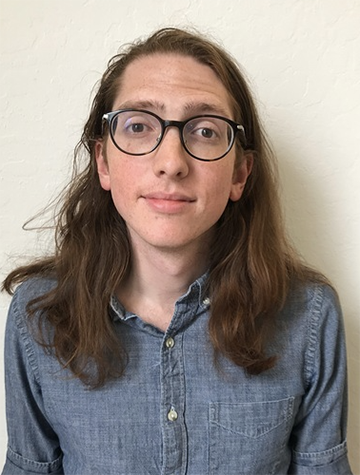
Ryder graduated from Rice in 2014 with a bachelor’s degree in mathematics before earning a Ph.D. at the University of California, Berkeley. He joined OpenAI shortly after completing graduate school and later became co-author of the landmark GPT-3 paper, “Language Models are Few-Shot Learners,” which helped reshape the field of artificial intelligence and large language models.
Now vice president of research for Foundations at OpenAI, Ryder leads large research and engineering teams working on the future of AI systems.
Looking back on his time at Rice, Ryder said the mathematics department’s openness and intellectual flexibility were transformative.
“It was a super welcoming department and let me push myself as hard as I wanted,” Ryder said. “Getting to go wherever my curiosity took me was really fantastic.”
He also pointed to the intersection of mathematics and computer science as an important through-line in his career.
“I’d always been very interested in the intersection of the two fields, and that ultimately led me to where I am today,” he said.
Outside the classroom, Ryder said Rice’s community and leadership opportunities also shaped him. He spent four years involved with student radio station KTRU and later managed the station during a period of major transition.
“Looking back, KTRU was probably my first serious attempt at leadership, and I think back to those days as evidence that I’ve always been drawn toward leadership and management,” Ryder said.
Ryder described witnessing the rapid rise of AI technologies as “extremely surreal.”
“When I joined the company, I was fascinated by the subject material, and I was fascinated by its potential,” he said. “It’s been very surreal to have conversations with a small group of people saying, ‘The world’s going to change in these ways,’ and then watch that go from a minority opinion to one of the top issues on people’s minds.”
Despite the rapid pace of AI development, Ryder said one of the most exciting possibilities is the technology’s potential to accelerate scientific discovery and mathematical research.
“The amount of advancement we can make towards knowledge is now just a matter of when and how,” he said.
The awards will be presented during the School of Natural Sciences awards dinner held as part of Alumni Weekend this fall.